



Activated Carbon Filter Comparison: What's Really Inside?
Not every activated carbon filter is built the same.
From the outside, many models look similar – inside, the differences are clear.
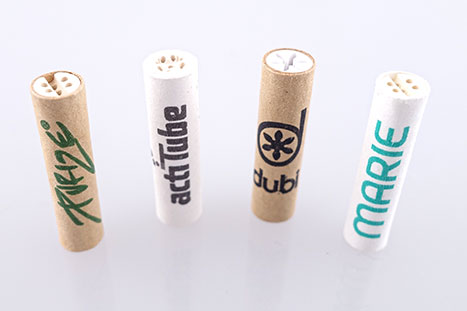
We opened and technically analysed four common activated carbon filters:
- Purize XTRA Slim 6 mm (Green)
- Dubi 7 mm (Made in Austria)
- Marie 6 mm
- ActiTube Slim 7 mm
No ratings. Just facts.
Why the Internal Structure Matters
An activated carbon filter essentially consists of:
- Paper sleeve
- Two end caps (ceramic or plastic)
- Activated carbon filling
- Internal structure for airflow guidance
These components affect:
- Airflow
- Draw resistance
- Particle retention
- Filtration consistency
- Durability
What matters is not just that activated carbon is included – but in what form, quantity, and structure.
Technical Analysis of the Models
Purize XTRA Slim 6 mm (Green)
Diameter: 6 mm
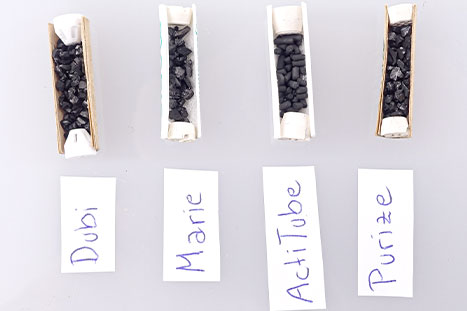
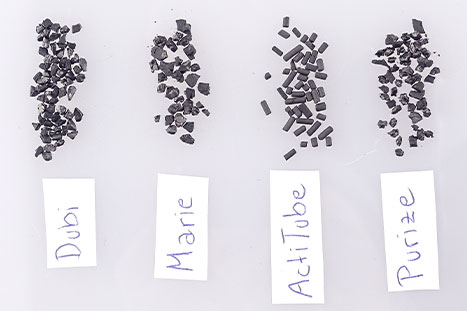
Carbon form: irregular, coarse granulate pieces
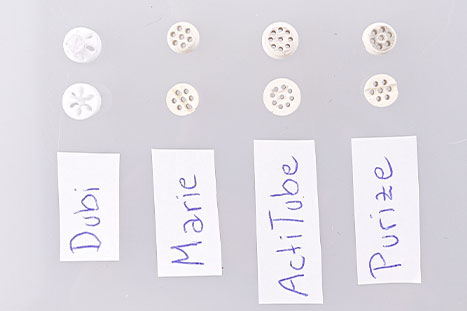
End caps: ceramic on both sides with multi-hole structure
Fill quantity (measured): approx. 0.13 g
The relatively coarse grain size of the activated carbon is notable.
The ceramic caps have multiple small openings designed to enable even air distribution.
Dubi 7 mm (Made in Austria)
Diameter: 7 mm
Carbon form: irregular, coarse granulate pieces
End caps: one side with a special star-shaped air structure
Fill quantity (measured): approx. 0.21 g
In comparison, Dubi has the highest measured fill quantity.
The activated carbon is coarsely structured. The internal construction stands out clearly due to the distinctive airflow guidance.
Marie 6 mm
Diameter: 6 mm
Carbon form: irregular granulate, tending finer than Dubi
End caps: ceramic with multi-hole design
Fill quantity (measured): approx. 0.14 g
The grain size is more compact than Dubi, but not pelletised.
The end caps resemble classic multi-hole ceramic elements.
ActiTube Slim 7 mm
Diameter: 7 mm
Carbon form: cylindrical pellets
End caps: ceramic with multi-hole structure
Fill quantity (measured): approx. 0.13 g
ActiTube uses pelletised activated carbon.
The uniform shape creates defined gaps within the filter body.
Direct Structural Comparison
|
Feature |
Purize |
Dubi |
Marie |
ActiTube |
|
Diameter |
6 mm |
7 mm |
6 mm |
7 mm |
|
Carbon form |
coarse granulate |
coarse granulate |
finer granulate |
pellets |
|
Fill quantity |
~0.13 g |
~0.21 g |
~0.14 g |
~0.13 g |
|
End caps |
multi-hole ceramic |
special structure |
multi-hole ceramic |
multi-hole ceramic |
Differences are particularly evident in:
- Grain size
- Fill quantity
- Airflow guidance
- End cap design
What to Look for Objectively
Regardless of brand or design, the following factors play a role:
1. Activated Carbon Grain Size
Granulate vs. pellet form affects air gaps.
2. Fill Quantity
More material does not automatically mean lower draw resistance – but it does change the contact surface area.
3. Diameter (6 mm vs. 7 mm)
Affects volume and airflow.
4. End Cap Design
The number and size of openings influence airflow guidance.
5. Fill Consistency
A homogeneous structure ensures stable airflow.
Conclusion
The differences are visible.
In the grain size.
In the fill quantity.
In the construction.
Which activated carbon filter suits you best depends on your priorities.
We took a look inside.
The decision is yours.
Team Dubi, Purize, ActiTube, or Marie?
Have your say on Instagram >> schallrauch_420